
In my last article, I explained why I’m continuing to build my email list even when a new subscriber doesn’t immediately turn into a sale.
For me, the answer is simple.
I’m building an asset and an audience for the long term.
But once somebody joins my email list, another important question comes up:
What do I actually send them?
It’s tempting when you first get into affiliate marketing to think every email needs to contain an offer.
Find a product.
Grab your affiliate link.
Send an email.
Repeat.
But that’s not how I want to build my business.
I’m trying to build something based on trust, useful information and relationships, rather than simply sending one promotion after another.
I Don’t Want Every Email to Say “Buy This”
Think about your own inbox.
What happens when somebody emails you every day and every message is another sales pitch?
After a while, you probably stop opening their emails.
Eventually, you may unsubscribe completely.
I know I do.
That’s why I’m trying to look at my email list differently.
Yes, I’m an affiliate marketer.
Yes, I’ll recommend products.
And yes, I hope those recommendations generate commissions.
But before somebody is likely to take my recommendation seriously, I believe they need a reason to trust me.
That trust has to be earned.
Sometimes I Simply Share What I’m Doing
A lot of the emails I write come directly from my own experience.
Right now, for example, Leanne and I are in the middle of another busy Snowy Mountains ski season managing our two motels.
That means my subscribers aren’t hearing from somebody sitting behind a computer all day with unlimited time to build an online business.
I’m dealing with many of the same challenges other people face.
Work.
Responsibilities.
Limited time.
Unexpected interruptions.
That’s why I share what I’m doing.
I might talk about how I’m finding time to work on my affiliate business.
I might explain what I’m learning through ClickBank Profit Club.
I might discuss a traffic campaign I’m trying.
Or I might share something I’ve discovered about building an email list.
These aren’t necessarily sales emails.
They’re part of my story.
I Use Email to Share My Blog Content
This blog is becoming an important part of my overall strategy.
When I publish a new article, I can send an email to my subscribers letting them know it’s available.
That gives me another reason to communicate without immediately asking them to buy something.
The email might simply say:
“I’ve just published a new article about something I’ve been working on. Here’s what I discovered…”
Then I can direct interested subscribers back to my website.
That helps me in several ways.
I’m keeping in contact with my subscribers.
I’m bringing visitors back to my own website.
I’m sharing useful information.
And I’m giving people another opportunity to get to know me.
All of that helps build trust.
I Try to Teach Something Useful
I also like emails that give someone a practical idea they can use.
It doesn’t have to be a 2,000-word training lesson.
Sometimes one useful idea is enough.
For example:
Build your email list before sending traffic directly to an affiliate offer.
That’s one lesson.
Another might be:
Don’t spend all your available time learning. Learn something and then implement it.
Or:
When you only have 30 minutes, choose one task that moves your business forward.
Simple lessons.
But useful ones.
If someone opens one of my emails and learns something that helps them, then I’ve given them a reason to open the next one.
I Share What I’m Learning
I’m certainly not pretending I know everything about affiliate marketing.
Far from it.
I’m still learning.
That’s part of why I joined ClickBank Profit Club.
So rather than presenting myself as someone who has all the answers, I prefer sharing the journey.
What am I learning?
What am I trying?
What worked?
What didn’t?
What would I do differently next time?
I think there’s value in that because many people on my list may be at a similar stage.
They don’t necessarily need another “guru.”
Sometimes it’s more useful to follow someone who is actually going through the process.
So When Do I Promote Something?
I absolutely do send promotional emails.
Affiliate commissions are part of the business I’m building.
But I want the promotion to make sense.
If I’ve been talking about building an email list and I know of a product that genuinely helps with list building, that’s a natural recommendation.
If I’ve been discussing traffic and discover a traffic resource I believe is worth considering, I can tell my subscribers about it.
And because I’m currently documenting my experience with ClickBank Profit Club, it’s also natural for me to tell people where they can learn more about it.
The difference is context.
Instead of:
“Here’s another product. Buy it.”
I’d rather explain:
“Here’s why I’m looking at this, here’s how it relates to what I’m doing, and here’s why I think you might want to take a look.”
That feels much more natural to me.
Trust Makes Promotions More Powerful
There’s another reason I don’t want every email to be promotional.
When every message contains a pitch, promotions stop feeling important.
But when subscribers are accustomed to receiving stories, useful information, lessons and updates, a recommendation stands out.
They know I’m not emailing them simply because I found another affiliate link.
That’s the kind of relationship I want to build.
Because ultimately affiliate marketing is based on recommendations.
And recommendations become more valuable when people trust the person making them.
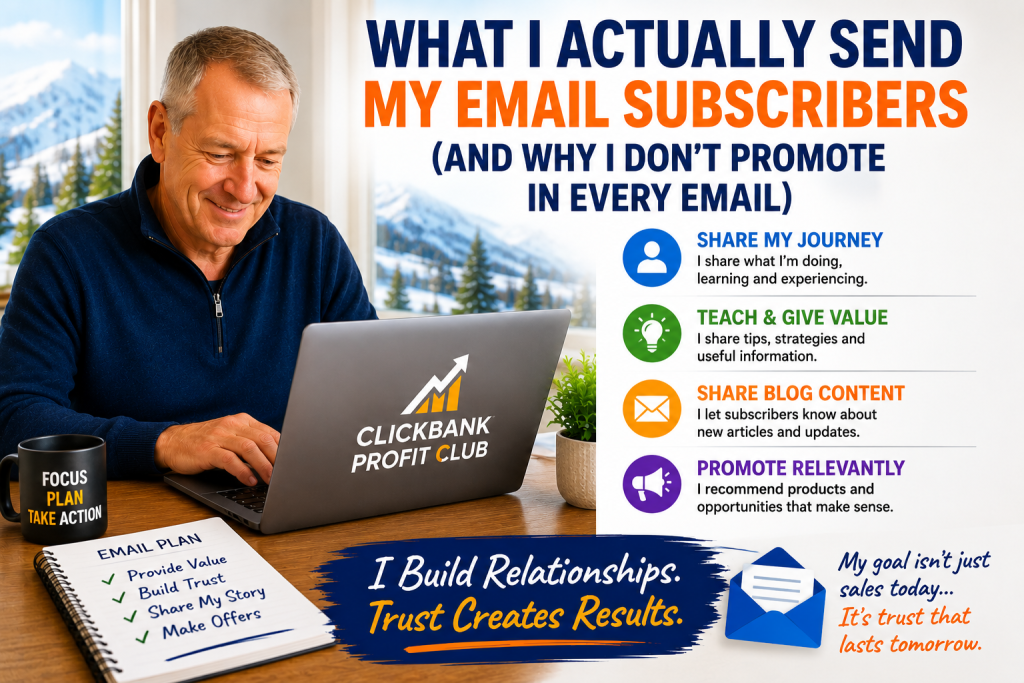
My Simple Email Content Mix
I don’t follow a rigid formula, but I like thinking about my emails in four broad categories:
1. Personal Journey
What I’m doing, learning and experiencing while building my business.
2. Useful Information
Practical affiliate marketing, list-building and traffic lessons.
3. Blog Updates
Sharing new articles and encouraging subscribers to visit my website.
4. Relevant Promotions
Products, tools and opportunities I genuinely believe are worth looking at.
That gives me plenty to talk about without turning every email into a sales pitch.
I’m Building a Relationship, Not Just a List
It’s easy to look inside an autoresponder and see numbers.
100 subscribers.
500 subscribers.
1,000 subscribers.
But every number represents a real person who made a decision to give you their email address.
I think that’s worth remembering.
My goal isn’t simply to build the biggest list possible.
I want to build a responsive list.
An audience that opens my emails.
Reads my articles.
Learns something from me.
Gets to know my story.
And, when I recommend something relevant, trusts me enough to at least take a look.
That doesn’t happen from one email.
It happens through consistency.
One useful message.
Then another.
Then another.
And gradually, you’re no longer emailing a list of strangers.
You’re building an audience.
That’s what I’m working toward with my ClickBank Profit Club business.
I’m still learning.
I’m still testing.
I’m still building.
But one thing I’m becoming increasingly convinced about is this:
Don’t treat every subscriber like today’s potential sale.
Treat them like someone you hope will still want to hear from you six months from now.
If you can achieve that, you’re building something far more valuable than a single commission.
You’re building trust.
And in affiliate marketing, trust may be one of the most valuable assets you can own.
To Your Success,
Graham Hill